


 TL;DR:
Odyssey-2 is a real-time, interactive AI video generator in a free research preview that uses a causal autoregressive architecture to stream live video at approximately 20 frames per second, allowing users to dynamically alter narratives, lighting, and scene physics mid-stream via text or audio prompts.
● Unlike Runway Gen-4 Turbo and OpenAI Sora which pre-render fixed 10-second clips, or Synthesia which relies on rigid scripts, Odyssey-2 generates new frames every 50 milliseconds, making it specifically suited for creators building open-ended gaming, continuous simulations, and unpredictable interactive storytelling.
● While accessible without a subscription during this experimental phase, the underlying technology demands intensive GPU resources with an estimated compute cost of US$1 to US$2 per user hour, and users may encounter prompt sensitivity or visual instability when attempting to render highly complex scenes.
● Since Odyssey-2 generates raw and continuously adapting emergent footage, users looking to publish commercial or social media content need to export their streams into an AI-equipped editing suite like Filmora to apply smart scene cutouts, synchronize voiceovers, and refine the generated assets into a finalized format.
Ask AI for a summary
 ChatGPT
 Perplexity
 Gemini
 Claude
 Grok
Grok
The development of AI-driven video creation is changing fast, and it is going beyond just static storytelling and easy template-based editing. The audiences of today are asking for content that seems real — something they can interact with, influence, and get in real time. The change has led to the birth of interactive AI video, a new type of video in which the visuals respond to the choices, behaviors, or actions of the user in a dynamic way. Viewers, instead of being passive, can decide the narrative, select the routes, open the scenes, or even get personalized results.
Anyway, the problem is that the traditional video editing tools are still very time-consuming, inflexible, and frequently have no features for creating engagement. The making of interactive experiences usually needs complicated workflows or programming skills, which are the factors that prevent most creators from reaching this powerful medium.
Odyssey-2 is here to help. As a next-generation interactive AI video creator, Odyssey-2 is making the process less complicated and more intelligent, a more user-friendly way of creating dynamic, responsive video content. In fact, it is a tool that is redefining how creative storytelling can work.
What Is Odyssey-2?
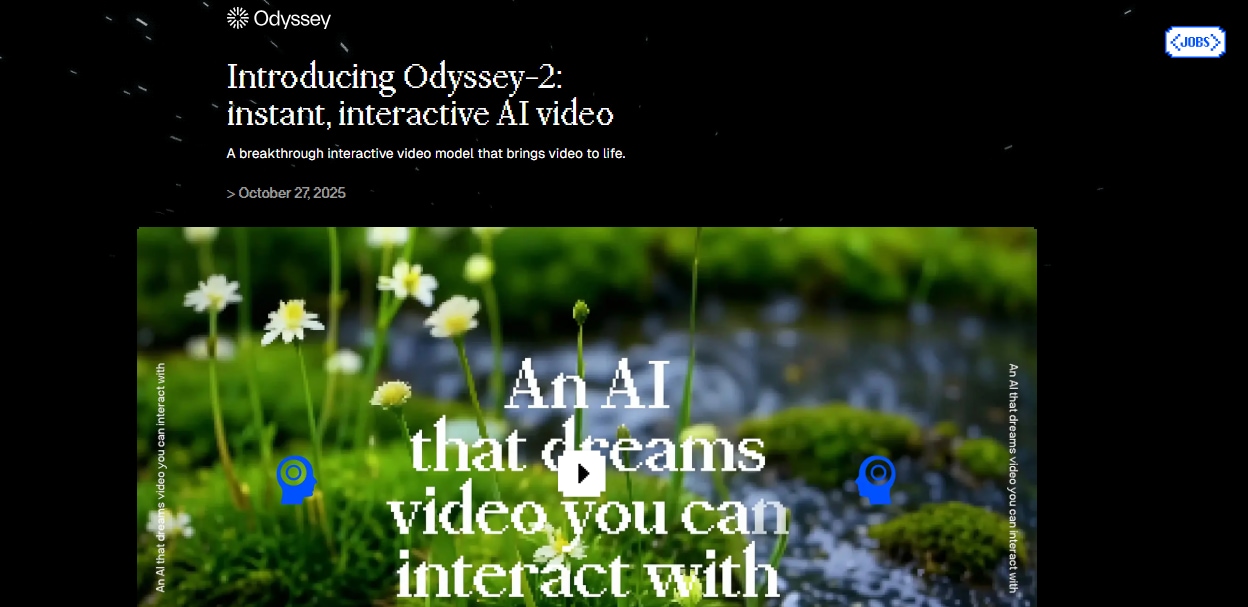
Odyssey-2 is an interactive AI video generator of the future that aims to make video look really 'alive.' In contrast to conventional prompt-to-video tools that yield fixed, pre-rendered clips, Odyssey-2 generates video on the fly, i.e., it can be a direct response to whatever you type or say without any delay. The key to this operation is its causal, autoregressive architecture, which determines each frame only from previous frames and your live inputs. Thus, the resulting video is not going to a predetermined location; rather, it keeps switching routes, thus enabling unlimited storytelling and the changing of the scene.
Basically, Odyssey-2 employs a very efficient, multi-stage training pipeline to achieve real-time rendering at about 20 frames per second—way below the time of a few minutes for bidirectional video models that can only render a few seconds. This velocity opens a plethora of new creative ideas in gaming, film, education, training, fooling, simulations, and whatnot. Available through a web interface and cross-device-compatible, Odyssey-2 is presently in the early access phase, and API support will be available soon for the developers and businesses that wish to integrate interactive AI video into their operations.
Key Features and Capabilities
- Real-time, interactive AI video generation — the model streams video instantly and can respond the very moment that you type, just like a language model.
- Causal autoregressive architecture which produces each frame only from past frames and user actions, thus allowing for open-ended, dynamic storytelling.
- Super speedy new frames are created every 50 milliseconds (≈20 FPS), thus the immersion is kept alive, and the users are freed from long waiting times for rendering.
- Extensive knowledge of the world and physics by the model that enables it to anticipate movement, lighting, contact, and even behaviors in a very realistic way—essentially functioning as an emerging world simulator.
- Continuous multi-minute video streaming is always ready to react to real-time input, hence giving creators the freedom to direct ongoing scenes, stories, and settings without having to predefine the endings.
Performance and User Experience
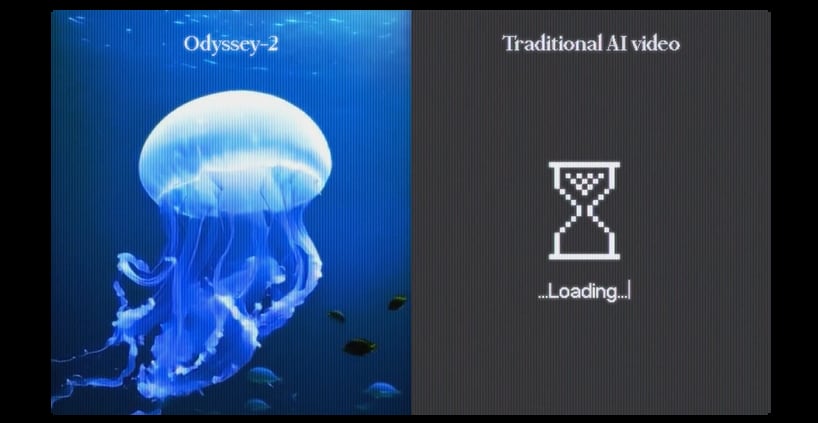
- Speed: In a very short time (around 50 milliseconds or approximately 20 fps), Odyssey-2 can show new frames, which is a major factor in the overall feeling of instant interaction. Runway Gen-4 Turbo and OpenAI Sora, on the other hand, produce a clip of about 10 seconds normally in less than 30 seconds. Thus, Odyssey-2 is largely more responsive than the usual render-first video generators.
- Stability: The causally, autoregressively functioning system of the device builds each frame based on the previous one, thereby eliminating the occurrence of large changes in the scene as well as visual glitches. The first users have found the motion to be smoother and the continuity to be more stable than those models that generate short clips separately and often have low fidelity in complex scenes.
- Visual Quality: The scenes created by Odyssey-2 are filled with natural movement, lighting, and world interactions due to its real-time physics modeling. Though it is not yet of full cinematic quality, it can be said that for an interactive, live-streaming AI model, the level of realism that it achieves is quite remarkable.
- Ease of Use: The interface is like chatting with an AI. You just enter the prompts and see the video changing accordingly. There are no timelines, no rendering, and no complicated installation, thus giving it a great advantage over tools like Gen-4 that need reference images to work.
- Learning Curve: Not only can a beginner figure out the tool quickly, but real-time feedback also makes prompt refinement easy. The process is sufficiently uncomplicated for the non-technical content creators.
Interactivity & Immersion
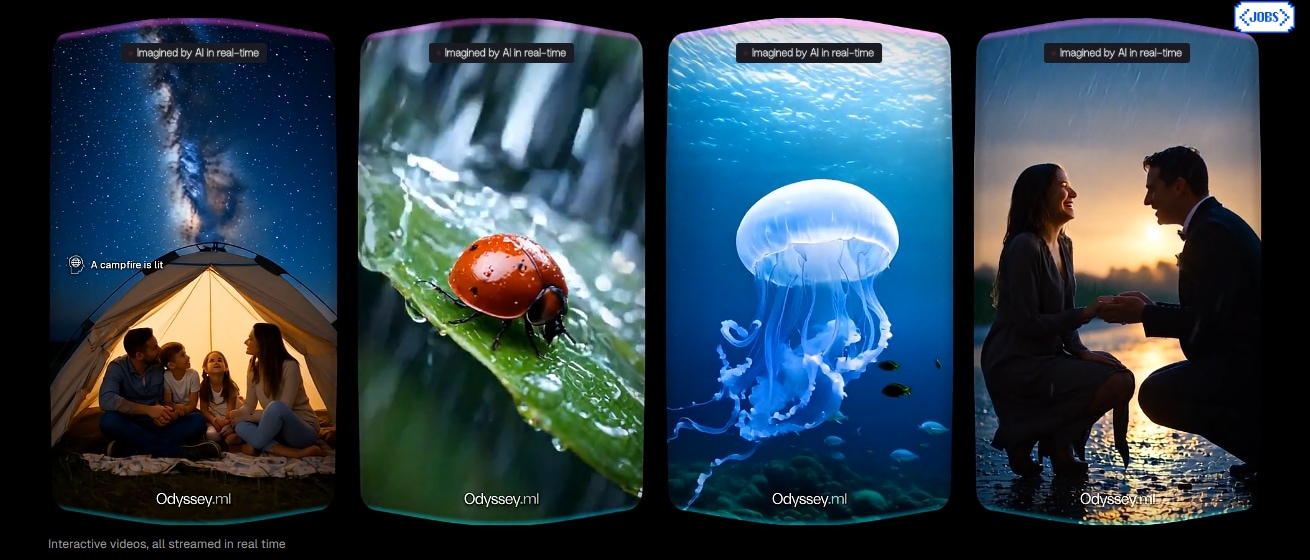
- Dynamic branching & real-time input: Odyssey‑2 is not stopping the adaptation of the video constantly as the interaction proceeds. Each deed or instruction alters the possible future of the story, thereby allowing really branching paths.
- Viewer influence & immersion: Viewers have the power to direct the scenes right there—changing characters, lighting, or setting instantly—thus, it is a great tool for storytelling, education, or gaming.
- Compared to Runway Gen‑4: Gen‑4 creates short, fixed clips that need to be pre-rendered; therefore, interactivity is very limited. Odyssey‑2 is a continuous, evolving video that can respond to your mid-stream.
- Compared to Synthesia: In contrast to Synthesia, which is mostly a script-driven approach, Odyssey‑2 supports open-ended, unpredictable interaction—users become the influencers of what happens next in the video.
AI Technology Under the Hood
- Neural video generation & world model: Odyssey‑2 comprises a causal, autoregressive video model that depicts each frame based on the prior context; thus, it is basically creating a live "world simulator". In effect, the system can produce realistic motion, lighting, and interactions on the fly because it doesn't have to rely on pre-rendered sequences.
- Spatial consistency & narrative control: The model has learned physics and scene dynamics from decades of video data, and it is able to keep the characters' spatial relationships, movement, and lighting even from the next frames. Using natural text or audio prompts, users can direct the narrative flow in real time.
- Integration with multimodal systems: The main idea behind Odyssey‑2 is to be able to support different input modalities in the future, i.e., text, speech, and possibly gestures that would allow more intimate interaction and deepen the user experience.
- Future potential: Such a design concept can serve as a springboard, opening vast grounds of possibilities such as gaming, education, simulation, and interactive storytelling wherein AI would be continuously adapting scenes based on user input and context, thereby creating lifelike experiences that are emergent.
Pricing and Availability
- Preview access: Odyssey‑2 is available as a free research preview for now, so users can try out the interactive video without needing a subscription.
- Compute cost: The cost of real-time video generation is approximately US$1–2 per user hour, changing with video quality.
- Early access: One can use the tool at present, but the availability might be limited to GPU resources, as it is still in the experimental stage.
- Commercial outlook: Use at full production or by an enterprise may require paid tiers or compute-based pricing later, but no definite commercial pricing has been disclosed.
Pros and Cons
- Real-time interactivity: The video is created on the spot; the system reacts to the user's input with very little delay (~50 ms per frame).
- High visual fidelity: The system can capture very detailed and realistic movements, lighting, and even physics for the most immersive scenes.
- Open-ended control: The users have the possibility to change video stories on the fly, just by giving a text or an audio prompt.
- Intuitive interface: A non-technical person would find it very simple, in the same way one would interact with a language model.
- Emergent applications: The technology has tremendous potential in areas such as gaming, education, simulation, and creative storytelling.
- Early-stage technology: The technology is still in the early stages of development, and thus, it may not be able to handle complex scenes correctly.
- Limited commercial availability: It is currently only available as a research preview; thus, full enterprise access may need paid tiers.
- Prompt sensitivity: The users might feel the need to keep adjusting their inputs till they get the desired result.
- Hardware dependent: The system needs very powerful computing resources which might not be accessible to some users.
Bonus - Filmora: The Perfect Companion for Odyssey-2 Creations
Although Odyssey‑2 is the primary mover that brings interactive AI video to life, Filmora is undoubtedly the best AI-powered editing suite to refine and elevate your work to the next level. It is like a bridge between raw, AI-generated clips and stylish, production-ready videos.
- AI Copywriting: Use AI to create scripts, captions, and text overlays that help interactive video storytelling.
- AI Scene Detection & Smart Cutout: Work with cutting-edge, AI-generated scenes in a heartbeat—removing the things you don't want or isolating the characters.
- AI Text-to-Speech & Audio Stretch: Impose or alter voiceovers on the fly and make the audio perfectly synchronized with the video content.
- AI Video Extender & Audio-to-Video Tools: Lengthen a short clip, attractively turn an audio into a video, and give yourself more options to tell your story.
- Creative Assets & Templates: Get access to millions of stock media assets, effects, transitions, tunes, stickers, and overlays for effortless post-production.
- Dual-Timeline & Keyframe Editing: Have complete control over the movement, timing, and transitions to tell your story in a precise and professional manner.
- Pen Tool & Animated Charts: Design seamless motion paths, modify curves, and use data-driven visuals for marketing or educational content.
- Drag-and-Drop Workflow: The user-friendly interface makes the work of editing very fast even in the case of beginners while the advanced tools give the professionals the opportunity to fine-tune the details.
 Secure Download
Benefits for Odyssey‑2 Creators:
Filmora is the tool of choice for creators who want to take the interactive AI-generated streams and make them into a video that can be published. It makes the process of post-production easy, gives more options to creativity, and is a tool that both beginners and professionals can use to make high-quality videos in a shorter time. No matter the use, be it for social media, education, storytelling, or marketing, Filmora is the guarantee that Odyssey‑2 content will be of the highest standard.
This pairing of Odyssey‑2's interactive AI generation with Filmora's AI-powered editing is the perfect solution for a smooth journey from the creator's mind to the final professional video.
Secure DownloadConclusion
Odyssey-2 is a significant leap in AI-powered interactive video, it changes the interaction with the media from being static to becoming a living, responsive experience. This is a result of its real-time video generation, understanding of the world-model, and being dynamically responsive to text, speech, and possibly gestures. As a result, it is possible to use the device for storytelling, learning, gaming, and immersive experiences in completely new ways. Odyssey-2 extends the limits of AI video by, among other things, ensuring spatial consistency and realistic lighting and allowing open-ended narrative control.
Creaters can use Filmora to elevate their Odyssey-2 project to the following degree—by producing, upgrading, and perfecting AI-generated video footage with the qualities of a professional video that is ready for publishing. The AI-powered editing tools of Filmora, the user-friendly workflow, and the vast creative assets make it possible for any interactive video to be designed, improved, and distributed without difficulty. In combination, Odyssey-2 and Filmora provide a robust network for creators, educators, and storytellers to embrace the upcoming wave of AI video.