


 100% Security Verified | No Subscription Required | No Malware

 ChatGPT
 Perplexity
 Gemini
 Claude
 Grok
Grok
A camera tracking app can help keep a moving subject properly framed without requiring you to manually adjust the crop throughout a video. Depending on the tool, tracking can be used to follow a speaker, reframe footage, create dynamic zooms, or apply effects that stay aligned with a moving subject.
Filmora provides different tracking workflows across mobile and desktop. On mobile, its AI-powered editing workflow can detect speakers and create dynamic framing for talking videos. On desktop, Camera Tracking can make the video frame follow a selected Head, Body, or Custom target.
This guide explains how these camera tracking workflows differ and shows you how to use them on iPhone, Android, Windows, and Mac.
In this article
- How Does Camera Tracking Work?
- Camera Tracking App for iPhone and Android: Filmora
- How to Use AI Camera in the Filmora App
- Camera Tracking on Desktop: Make the Frame Follow a Subject
- Camera Tracking vs. Face Tracking vs. Motion Tracking
- Bonus: How to Add Face Tracking Video Effects
- Frequently Asked Questions
Part 1. How Does Camera Tracking Work?
In video editing, camera tracking can refer to different workflows depending on the software. For creator-focused editing, one common goal is to keep an important subject properly framed as they move.
The software analyzes the footage, identifies the selected person or object, follows its movement across frames, and adjusts the framing based on the tracking result.
This can be especially useful for:
- Talking-head videos
- Podcasts and interviews
- Vlogs
- Dance and fitness videos
- Sports footage
- Pet videos
- Product demonstrations
- Short-form social videos
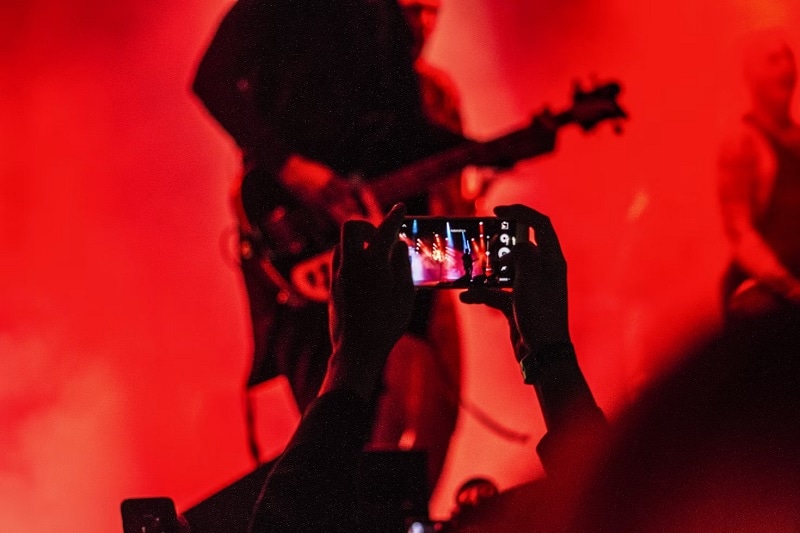

Is a Camera Tracking App the Same as a Face Tracking App?
No. Although both technologies analyze movement, they are generally used for different editing tasks.
Subject-following camera tracking focuses on maintaining framing around a moving subject. The goal is usually to keep a person, pet, product, or another target better positioned within the video frame.
Face tracking focuses specifically on detecting and following a face or facial features. It is commonly used for AR effects, masks, filters, stickers, beauty effects, and other face-aware editing tasks.
Part 2. Camera Tracking App for iPhone and Android: Filmora
If you're editing talking videos on a phone, Wondershare Filmora provides AI-assisted tools for automatically creating more dynamic framing around speakers.
Filmora's mobile AI Camera workflow works together with speaker-aware editing and AI Captions. This makes it particularly useful for podcasts, interviews, talking-head videos, and short-form content where the active speaker should remain visually prominent.
 Secure Download
Highlights of Filmora AI Camera
- Dynamic Framing: Creates changing framing and zoom effects around speakers to make talking videos more visually dynamic.
- Speaker Detection: Detects speakers in talking videos and supports speaker-aware editing.
- Adjustable Framing: Lets you refine the generated framing when the automatic result needs adjustment.
- Speech Editing: Provides speech-related editing controls within the AI-powered workflow.
- AI Captions: Generates captions from spoken audio.
- Caption Customization: Provides additional controls for styling and editing generated captions.
Part 3. How to Use AI Camera in the Filmora App
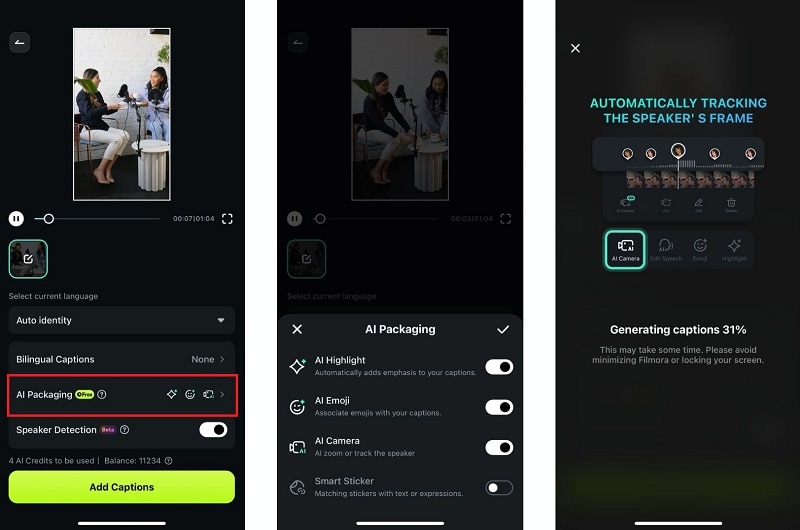
The Filmora mobile workflow combines AI Camera with speaker-aware editing and captions, making it suitable for podcasts, interviews, commentary videos, and other speech-driven content.
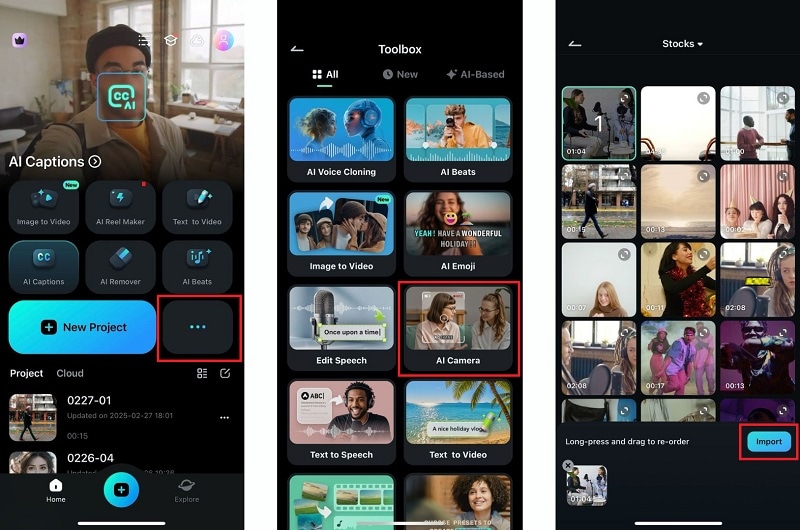
How to Use Filmora AI Camera
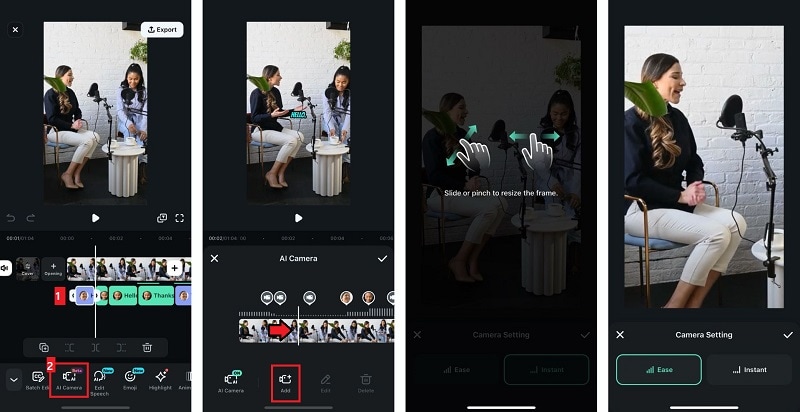
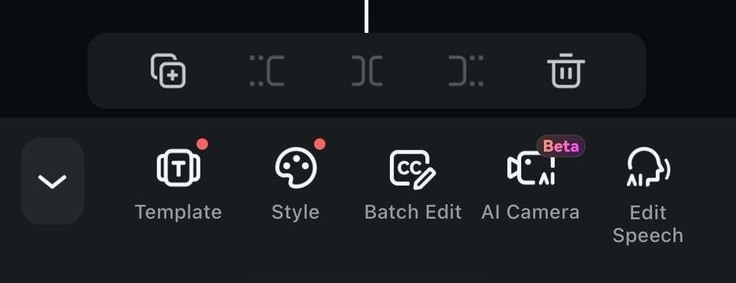
- Step 1:Open Filmora and Access AI Camera
- Step 2:Import Your Video
- Step 3:Choose the AI Settings
- Step 4:Review the Result
- Step 5:Adjust the Framing
- Step 6:Edit Captions and Speech
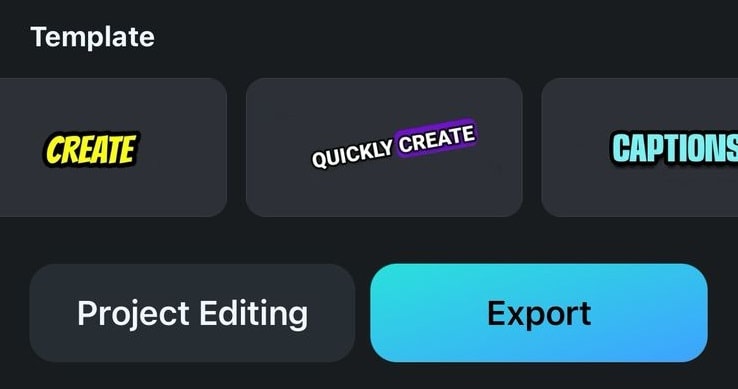
- Step 7:Export the Video
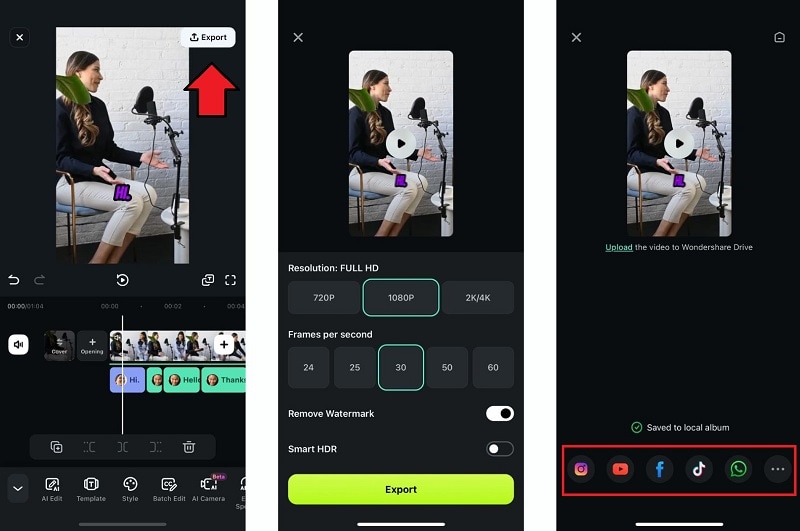
Part 4. Camera Tracking on Desktop: Make the Frame Follow a Subject
The mobile AI Camera workflow above is designed primarily for AI-assisted talking-video editing. If your goal is more directly to make the video frame follow a moving subject, Filmora also provides dedicated Camera Tracking on desktop.
Filmora Camera Tracking analyzes a selected subject and adjusts the framing as that subject moves. This reduces the need to repeatedly reposition the crop with manual keyframes.
What Can Filmora Camera Tracking Follow?
You can choose from three tracking target modes:
- Head: Follow a person's head in interviews, lessons, presentations, talking-head videos, and vlogs.
- Body: Follow full-body movement in dance, fitness, sports, and other action footage.
- Custom: Define another target such as a pet, product, prop, or moving detail.
How to Use Camera Tracking in Filmora
01of 03Import the Video
Launch Filmora, create a project, import the video you want to track, and drag it onto the timeline.
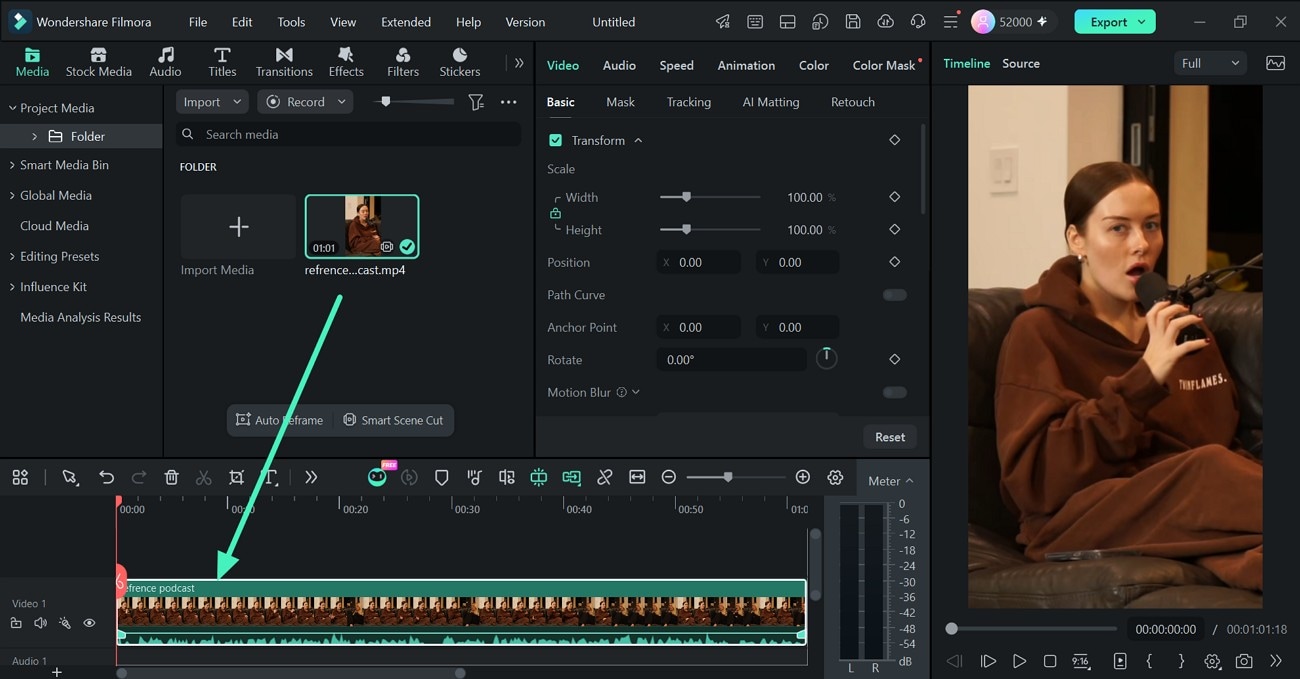
02of 03Choose the Camera Tracking Target
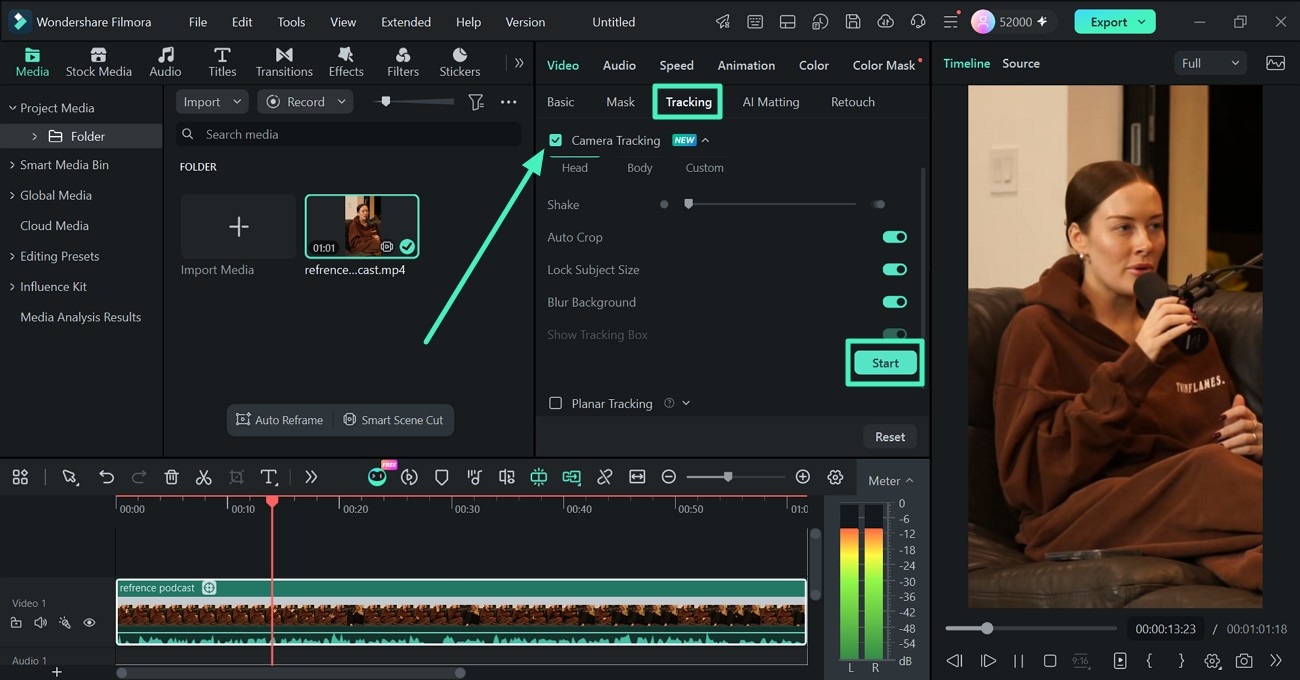
Select the video clip and go to Video → Tracking → Camera Tracking. Choose Head, Body, or Custom depending on the subject you want the frame to follow.
Adjust the available tracking and framing controls as needed, then click Start to analyze the movement.
03of 03Preview and Fine-Tune the Framing
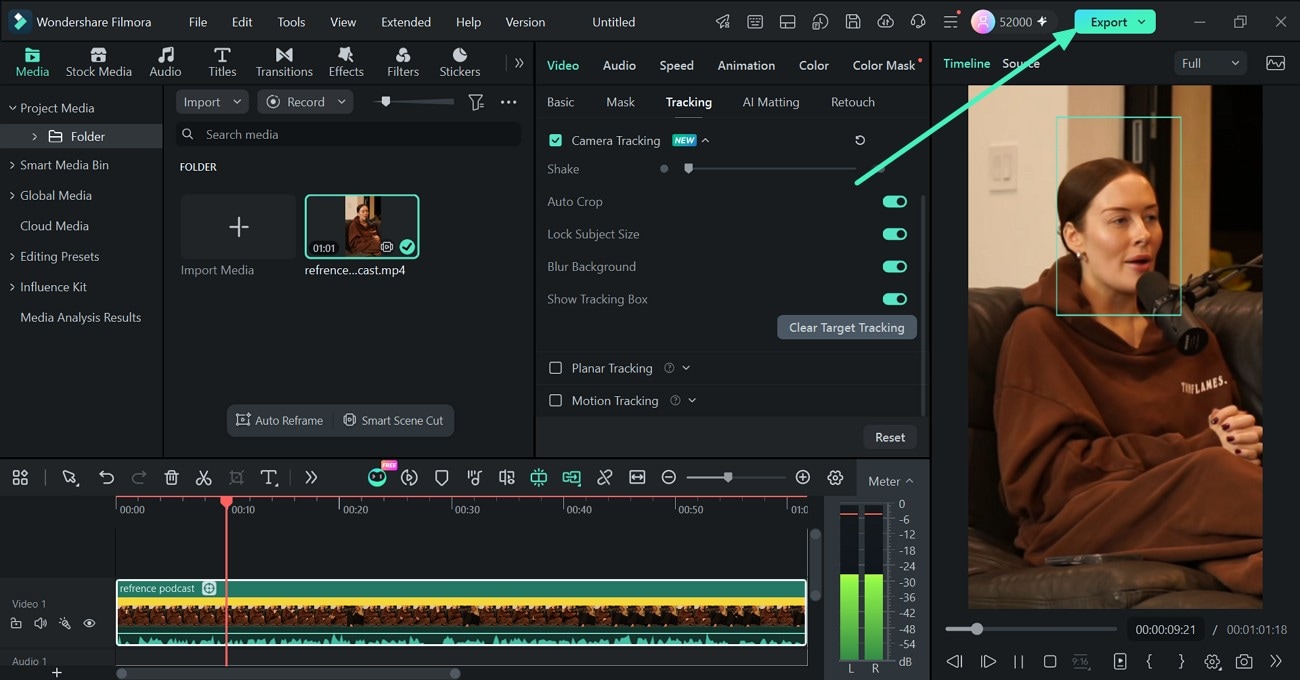
After the tracking analysis is complete, preview the result and check how the frame follows the subject. Adjust the available settings or retrack the clip if necessary.
When the result looks right, export the finished video.
For the complete workflow, see the Filmora Camera Tracking Guide for Windows or Camera Tracking Guide for Mac.
Part 5. Camera Tracking vs. Face Tracking vs. Motion Tracking
Camera Tracking, Face Tracking, and Motion Tracking all involve analyzing movement, but the editing result is different.
| Feature | What It Tracks | What Happens | Common Uses |
|---|---|---|---|
| Camera Tracking | Head, body, or custom subject | The video framing follows the selected subject | Vlogs, dance, fitness, pets, products, talking-head videos |
| Face Tracking | Face or facial features | A face-aware effect stays aligned with the face | AR effects, filters, masks, stickers |
| Motion Tracking | Moving object or selected area | An added element follows the tracked target | Text labels, graphics, mosaics, callouts, stickers |
Bonus: How to Add Face Tracking Video Effects
If your goal is to add an effect that stays aligned with a person's face rather than reframe the entire video, a face-aware effect is the more appropriate workflow.
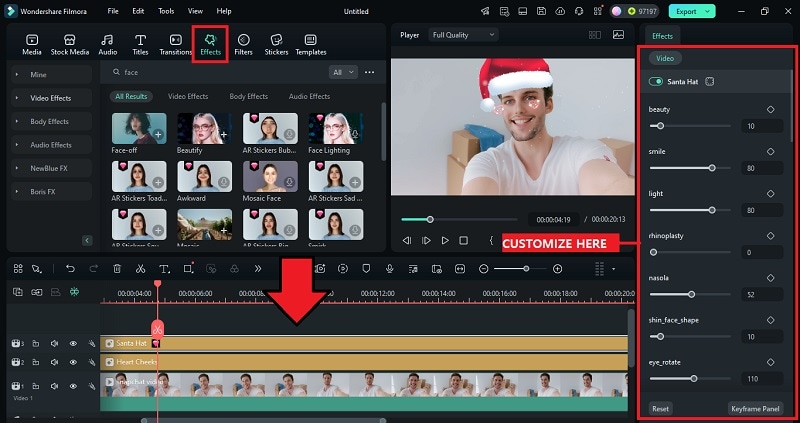
Filmora for desktop includes video effects that can be used for creative face-focused edits. The exact available effects can vary by Filmora version and effects library.
How to Add Face Effects in Filmora
- Step 1:Import the Video
- Step 2:Find and Apply an Effect
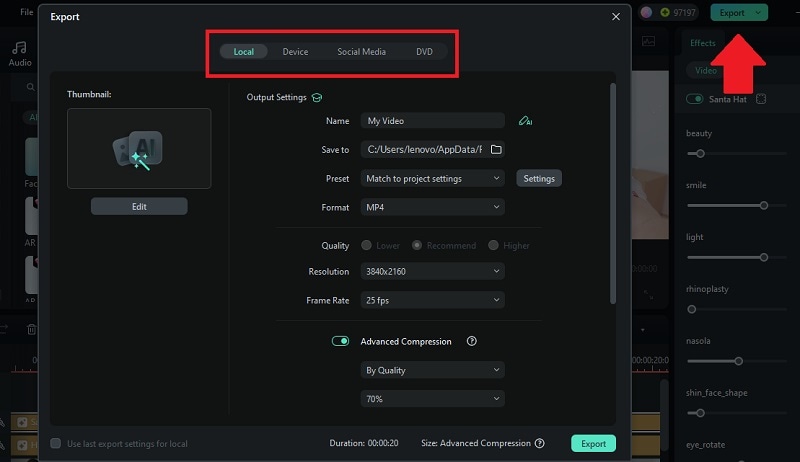
- Step 3:Preview and Export
Frequently Asked Questions
What is a camera tracking app?
A camera tracking app analyzes movement in video and can use that information to help maintain framing around a selected subject. Depending on the software, camera-related AI tools may also create dynamic framing or zoom effects for talking videos.
Can Filmora automatically follow a moving subject?
Yes. Filmora's desktop Camera Tracking can make the video frame follow a selected Head, Body, or Custom target. Filmora mobile also provides AI-assisted framing tools for speech-driven videos.
What can Filmora Camera Tracking follow?
Filmora Camera Tracking provides Head, Body, and Custom target modes. Head is suited to face-focused compositions, Body to full-body movement, and Custom to other moving subjects such as pets, products, or props.
What is the difference between Camera Tracking and Motion Tracking in Filmora?
Camera Tracking makes the video frame follow the selected subject. Motion Tracking keeps the original framing and makes another element, such as text, an image, graphic, mosaic, or sticker, follow a moving target.
Is Camera Tracking the same as Face Tracking?
No. Camera Tracking changes the framing to follow a selected subject. Face Tracking focuses specifically on a face or facial features and is commonly used to keep filters, masks, AR effects, or other face-aware elements aligned.
Is Filmora Camera Tracking the same as 3D Camera Tracking?
No. Filmora Camera Tracking is a subject-following reframing tool. Traditional 3D Camera Tracking, also called matchmoving or camera solving, estimates how a camera moved through a three-dimensional scene for VFX and 3D compositing.
Conclusion
A camera tracking app can simplify editing when your subject moves around the frame. The right workflow, however, depends on what you're editing.
For speech-driven videos on iPhone or Android, Filmora's mobile AI Camera workflow combines dynamic framing with speaker-aware editing and captions. For desktop projects where the goal is specifically to keep a moving person, pet, product, or other subject framed, Filmora Camera Tracking provides dedicated Head, Body, and Custom tracking modes.
If your goal is different, choose the corresponding tracking workflow: use Motion Tracking when another element should follow an object, or use face-aware effects when an effect needs to stay aligned with a person's face.