

 100% Security Verified | No Subscription Required | No Malware


 ChatGPT
 Perplexity
 Gemini
 Claude
 Grok
Grok
The world of AI image generation is advancing at a breathtaking pace. In 2025, two models have emerged as dominant forces, reshaping how creators produce visual content: ByteDance's Seedream 4.0 and Google's Nano Banana. While both offer state-of-the-art capabilities, they are built for fundamentally different creative workflows.
This article provides a detailed Nano banana and seedream comparison, breaking down their performance in image quality, editing control, speed, and platform integration. More importantly, we'll explore how Wondershare Filmora's upgraded AI Image generator, now powered by Nano Banana, puts world-class AI capabilities directly into your video editing timeline.
Part 1: What Are Seedream 4.0 and Nano Banana?
Before diving into a direct seedream 4.0 vs nano banana analysis, let's understand what makes each model unique.
Seedream 4.0 Overview
Developed by ByteDance, Seedream 4.0 is a high-fidelity multimodal model engineered for professional-grade output. Built on a sophisticated 12-billion parameter Mixture of Experts (MoE) architecture, it unifies generation and editing into a single, powerful engine.
Core Strengths: Its standout features include being the first model in its class to support 4K ultra-HD output, exceptional prompt adherence, and the ability to use up to 10 reference images for highly controlled, context-aware generation. It excels at producing realistic lighting, sharp details, and accurate text rendering.
Best For: Professional creators, design studios, and commercial projects that prioritize pixel-perfect quality and detailed control over visual elements.
Nano Banana Overview
Nano Banana, part of Google's Gemini 2.5 Flash family, is built for speed, flexibility, and creative iteration. It leverages a conversational AI framework that allows it to understand and execute edits from simple, natural language prompts with remarkable precision.
Core Strengths: Its main advantages are lightning-fast generation (delivering results in seconds), unparalleled character consistency across multiple edits, and intuitive text-based editing that feels like a conversation.
Best For: Video creators, social media managers, and marketers who need to generate high-quality visuals quickly and efficiently for daily content, storyboards, and rapid prototyping.
Part 2: Detailed Comparison: Seedream 4.0 vs Nano Banana
How do these two powerhouses stack up in a head-to-head matchup? Let's analyze the key differences that matter most to creators in this nano banana vs seedream 4.0 showdown.
1. Image Quality and Style Output
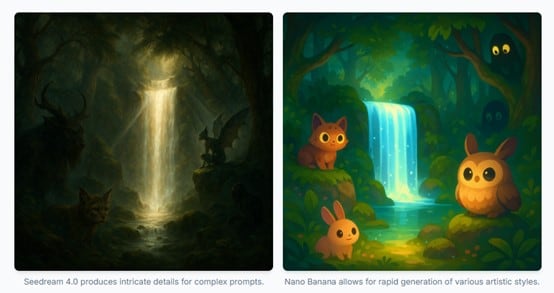
When it comes to raw resolution, Seedream 4.0 has a clear edge with its native 4K output. This makes it the go-to choice for creating print-ready marketing assets, detailed concept art, or visuals that require significant post-production and cropping. Its outputs are often described as professional, sharp, and photorealistic.
Nano Banana, while not focused on 4K generation, produces hyper-realistic and physics-aware visuals with coherent lighting and shadows. Its strength lies in stylistic versatility and speed, allowing creators to rapidly generate polished, stylized images perfect for social media, video thumbnails, and online content without needing extensive refinement.
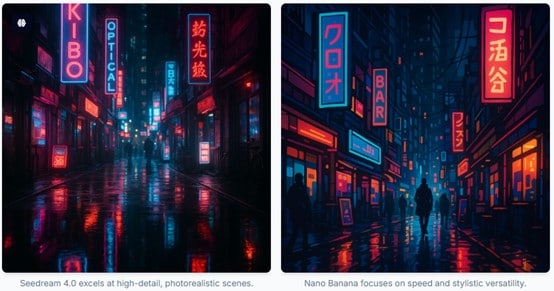
Tips: Choose Seedream 4.0 for ultimate detail and resolution. Choose Nano Banana for high-quality, stylized visuals generated in seconds.
2. Text Prompt Accuracy and Editing Control
Both models excel at interpreting prompts, but their approach to editing differs significantly.
Seedream 4.0 offers deep, multimodal control. Users can combine text with up to 10 reference images, enabling complex tasks like style migration and multi-image fusion. Its knowledge-driven generation can even create accurate diagrams and charts, making it a powerful tool for intricate design work.
Nano Banana shines with its conversational, text-based editing. You can simply tell the AI to "change the woman's jacket from red to blue" or "add a dog sitting on the grass," and it executes the command while preserving the character's identity and the scene's lighting. This "one-shot" editing capability makes it incredibly intuitive and efficient for quick modifications.
3. Generation Speed and Workflow Efficiency
This is where the nano banana vs seedream 4.0 comparison becomes stark. Nano Banana is built for speed. It can generate images in as little as 5 seconds and perform edits in milliseconds, reportedly making it up to 20 times faster than models like DALL-E 3. This enables an incredibly fluid and iterative workflow where creators can test dozens of ideas in minutes.
Seedream 4.0 is also fast for its quality, generating a 2K image in under 2 seconds. However, for rapid-fire creative brainstorming and on-the-fly asset generation, Nano Banana's near-instantaneous feedback loop is a game-changer.
4. Scene and Character Consistency
Maintaining visual identity is crucial for storytelling, branding, and video series.
Seedream 4.0 provides excellent batch consistency, allowing you to generate multiple images at once that share a consistent style and content.
Nano Banana is the industry leader in character consistency across unlimited edits. It achieves up to 95% character accuracy, ensuring a person's face, body, and features remain identical even as you change their clothing, pose, or background. This is invaluable for creating storyboards or consistent character visuals for a video.

5. Platform Integration and Accessibility
A model's power is only useful if it's accessible. Seedream 4.0 is primarily available through APIs and specialized developer platforms, requiring a more technical setup.
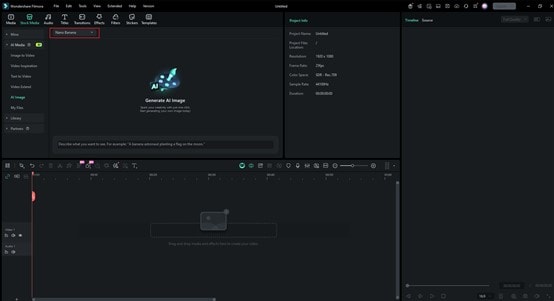
This is Nano Banana's killer advantage for most creators: it's integrated directly into Wondershare Filmora. Filmora's AI Image generator lets you harness Nano Banana's power without ever leaving your video editor. You can generate backgrounds, overlays, or character concepts and drop them straight onto your timeline, creating a seamless, unified workflow.

 secure download

Part 3: Which AI Image Generator Is Right for You?
The right choice in the seedream 4.0 vs nano banana debate depends entirely on your creative needs.
Pros and Cons Overview
|
Feature |
Seedream 4.0 |
Nano Banana |
|
Image Quality |
⭐⭐⭐⭐⭐ 4K ultra-high detail. |
⭐⭐⭐⭐ Hyper-realistic and stylized visuals. |
|
Editing Flexibility |
⭐⭐⭐⭐⭐ Multimodal inputs, deep control. |
⭐⭐⭐⭐ Intuitive, conversational text-based edits. |
|
Generation Speed |
⭐⭐⭐⭐ Fast (2K image in ~1.8s). |
⭐⭐⭐⭐⭐ Lightning-fast (edits in milliseconds). |
|
Consistency |
Excellent for batch style consistency. |
Unmatched for character consistency across edits. |
|
Ecosystem |
Primarily APIs and developer tools. |
Directly integrated into software, like Filmora. |
|
Best For |
Commercial studio projects, print, concept art. |
Video content, social media, rapid prototyping. |
Which Model Fits Your Workflow?
Choose Seedream 4.0 if: You are a professional designer or studio that requires the absolute highest resolution for commercial print, detailed architectural renders, or film-grade concept art. You are comfortable working with APIs and need granular control over every pixel.
Choose Nano Banana if: You are a video creator, marketer, or content producer who values speed, efficiency, and a streamlined workflow. You need to generate compelling visuals for thumbnails, backgrounds, B-roll, and social media posts without switching between multiple apps.
Hybrid Tip: For the best of both worlds, prototype your ideas rapidly using Nano Banana inside Filmora. Once you've perfected your concept, you can use a high-resolution model like Seedream 4.0 for the final hero asset if needed.
Part 4: Create AI Images Directly in Filmora with Nano Banana
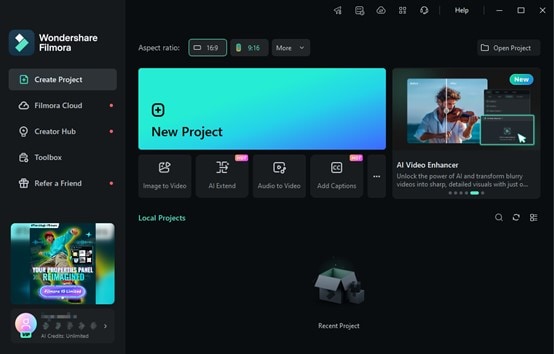
For video creators, the choice is clear. The integration of Nano Banana into Filmora's AI Image generator eliminates friction and supercharges your creative process. Instead of juggling different websites, subscriptions, and downloads, you can generate stunning visuals right where you need them: in your video editor.
 secure download
Key Features of Filmora's AI Image (Nano Banana Mode):
- Smarter idea-to-image generation
With the Nano Banana model, Filmora now understands prompts more precisely — generating images that better match your intent with richer details and more natural compositions.
- Sharper quality and finer details
Nano Banana's advanced visual engine enhances texture, lighting, and realism, producing cleaner, more professional-looking results right from your first try.
- More consistent subjects and styles
The model keeps your characters and objects visually consistent, even when switching styles or backgrounds — perfect for creating cohesive visuals across a project.
- Smoother creative workflow inside Filmora
Thanks to Nano Banana's faster rendering and higher accuracy, AI-generated images now fit seamlessly into Filmora's editing timeline with less need for manual retouching.
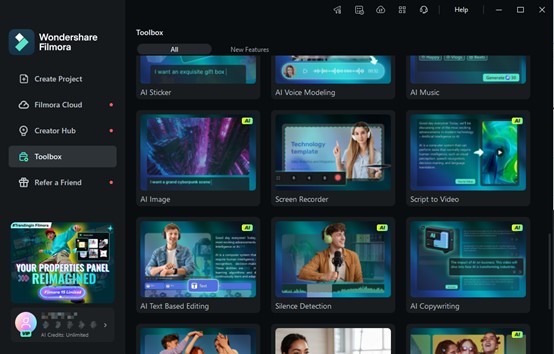
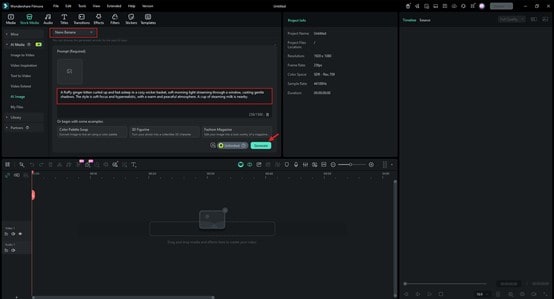
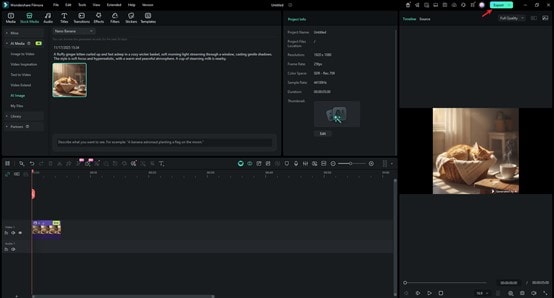
Steps of using Filmora AI image
Step-by-Step Guide:
 secure download
Conclusion
Both Seedream 4.0 and Nano Banana are incredible tools that mark a significant leap forward in AI visual creation. Seedream 4.0 pushes the boundaries of quality and professional control, while Nano Banana redefines speed and workflow integration.
While the nano banana and seedream comparison shows both have their strengths, the right choice ultimately depends on your goals. For the vast majority of video creators, Nano Banana's combination of speed, quality, and seamless integration inside Wondershare Filmora offers the most intuitive and powerful path to bringing your creative vision to life.